
Start with meaning, then connect the shape
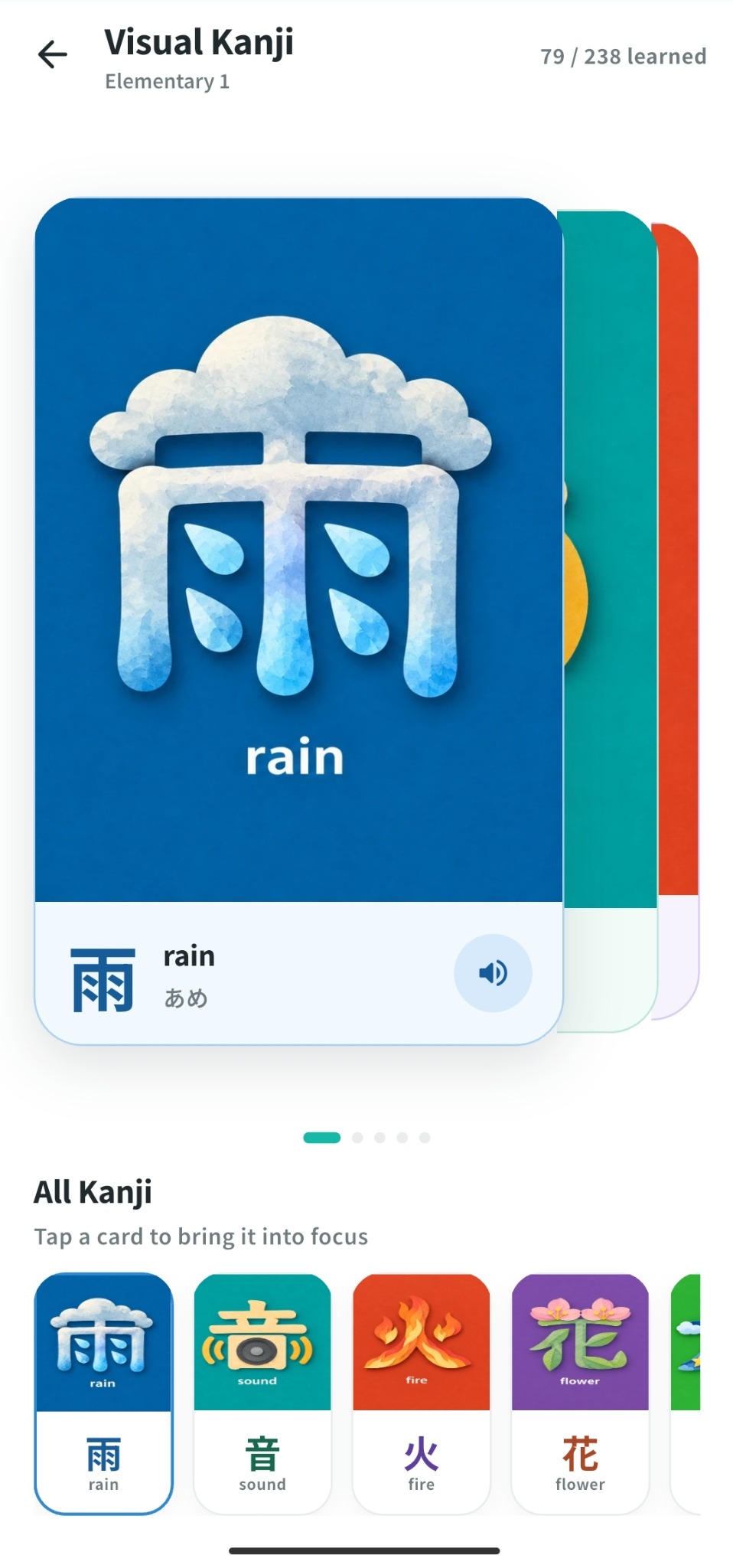
When a new kanji has no meaning attached to it, every stroke competes for attention. A visual association gives the character a memorable first anchor. For example, Michi’s Visual Kanji approach turns the meaning of a character into artwork that echoes its shape, then asks you to recall the connection.
The goal is not to remember the artwork forever. The goal is to make the real kanji easier to retrieve from memory.
Learn readings through words, not isolated sound lists
Many kanji have more than one reading. Beginners often get stuck trying to memorize every possible pronunciation at once. A more useful approach is to learn a reading inside a common word, where the sound has context.
That keeps kanji connected to vocabulary instead of turning it into a separate subject that never reaches real Japanese.
Use stroke order as writing support
Stroke order is useful for handwriting, character recognition and understanding how components fit together. You do not need perfect calligraphy before moving on, but tracing and writing practice can reinforce the structure of the character.
Michi combines kanji study with stroke-order practice so visual memory and physical writing can support each other.
Recall is stronger than passive review
Looking at a card and thinking “I knew that” feels productive, but retrieval is the real test. Try to recall the meaning before revealing it. Then meet the kanji again in vocabulary and sentences. Each successful retrieval makes the memory easier to access later.
This is why Michi’s visual-memory flow asks you to think first and reveal second.
PRACTICE IT IN MICHI
Turn the explanation into practice.
Michi connects kana, kanji, vocabulary, grammar patterns and sentence building in one beginner-friendly path.

